Rodent activity in Franklin County residences increases sharply during late-autumn temperature drops, driving Norway rats and white-footed mice toward heated wall voids and crawlspaces. Architectural rodent exclusion…
Rodent activity in Franklin County residences increases sharply during late-autumn temperature drops, driving Norway rats and white-footed mice toward heated wall voids and crawlspaces. Architectural rodent exclusion addresses this intrusion systematically by targeting mechanical vulnerabilities rather than merely replenishing bait stations. In historic properties throughout German Village and Victorian Village, fieldstone basements and aging sill plates develop mortar fissures exceeding 0.25 inches, the exact clearance needed for a juvenile field mouse to breach a perimeter according to the Centers for Disease Control and Prevention seal-up guidelines. Installing rigid structural barriers stops entry along subterranean ledges, whereas routine chemical treatments leave the physical runway intact, inviting subsequent colonies once the pesticide degrades.
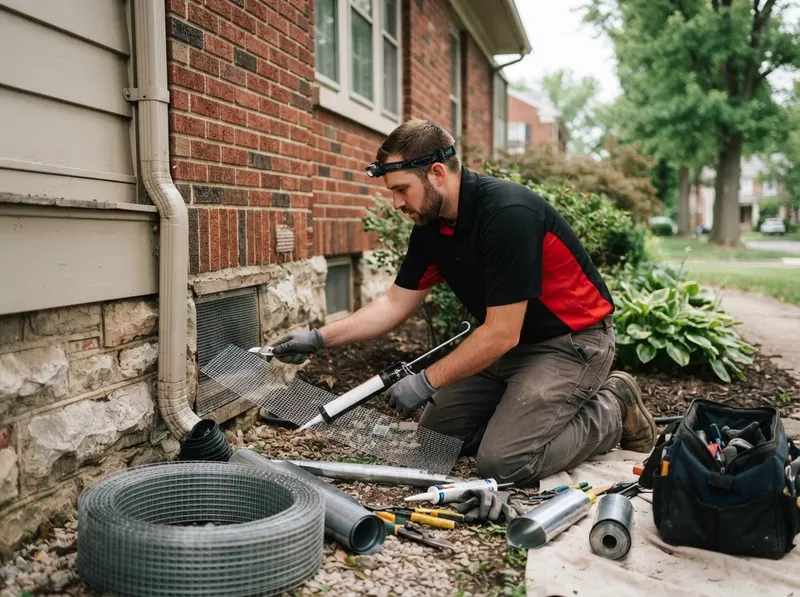
Technicians conduct a 360-degree diagnostic survey examining roof ridge vents, fascia returns, air conditioning chase lines, and exterior plumbing stacks. In mid-century brick ranches across Upper Arlington and Bexley, weep holes along masonry water tables provide direct passage to drywall bays. These portals are secured using custom-formed 16-gauge ASTM-standard galvanized steel wire cloth, preventing gnaw-through while preserving essential wall cavity ventilation as recognized by the U.S. Department of Housing and Urban Development Healthy Homes Program. In addition, technicians examine attic rafters near mature tree lines in Clintonville and Worthington Hills, sealing roof transitions in compliance with interNACHI roof inspection standards to halt roof rat ingress without disrupting attic airflow.
The trade-off between architectural exclusion and chemical suppression involves upfront investment versus recurring lifecycle expense. Standard chemical rodent maintenance averages $50 to $90 per month indefinitely but allows toxicant-fed rodents to expire within hidden wall voids, releasing secondary contamination and odors. Structural exclusion requires an initial capital layout ranging from $450 for localized foundation gaps to $2,400 for comprehensive multi-story roofline retrofits, yet it mechanically eliminates domestic intrusion indefinitely. Technicians install tension-loaded, one-way exit funnels conforming to humane displacement protocols established by the Wildlife Hotline technical standards, enabling trapped animals to vacate attic insulation without re-entering.
Biological decontamination follows mechanical closure to restore domestic sanctuary. Rodent excrement deposits harbor bacterial pathogens, including Salmonella and Streptobacillus moniliformis, as documented by the Ohio Department of Health zoonotic surveillance. Technicians apply non-VOC, hospital-grade biocides meeting EPA antimicrobial standards to soiled floorboards and joists along the Olentangy and Scioto river corridors, neutralizing pheromone scent trails that attract outside colonies. Air quality monitoring adheres to OSHA indoor air quality benchmarks to safeguard companion animals and household residents during remediation. Homeowners receive photographic documentation verifying sealed perimeters, backed by clear engineering tolerances, ensuring residential structures remain biologically fortified throughout seasonal freeze-thaw cycles.
Every job gets a firm, written price after a free on-site visit.
Tell us about your architectural rodent exclusion job in Columbus and we'll send a clear, written quote, usually the same day.
 WillowForge Pest Care