Seasonal mosquito mitigation requires addressing environmental vectors before adult swarms disrupt domestic properties. In Central Ohio, mosquito activity aligns with fluctuating humidity and river-basin topography.…
Seasonal mosquito mitigation requires addressing environmental vectors before adult swarms disrupt domestic properties. In Central Ohio, mosquito activity aligns with fluctuating humidity and river-basin topography. Neighborhoods bordering the Olentangy and Scioto rivers, such as Clintonville, Victorian Village, and Franklinton, experience heavy populations of Culex mosquitoes due to natural riparian corridors. Shaded historical brick courtyards in German Village and dense landscaping in Bexley, Grandview Heights, and Upper Arlington retain moisture in drainage basins, ornamental fountains, and perimeter ivy. Left unchecked, stagnant water surfaces provide immediate breeding sites for female mosquitoes laying batches of 100 to 200 eggs at a time, requiring mechanical mitigation alongside organic or synthetic barrier applications.
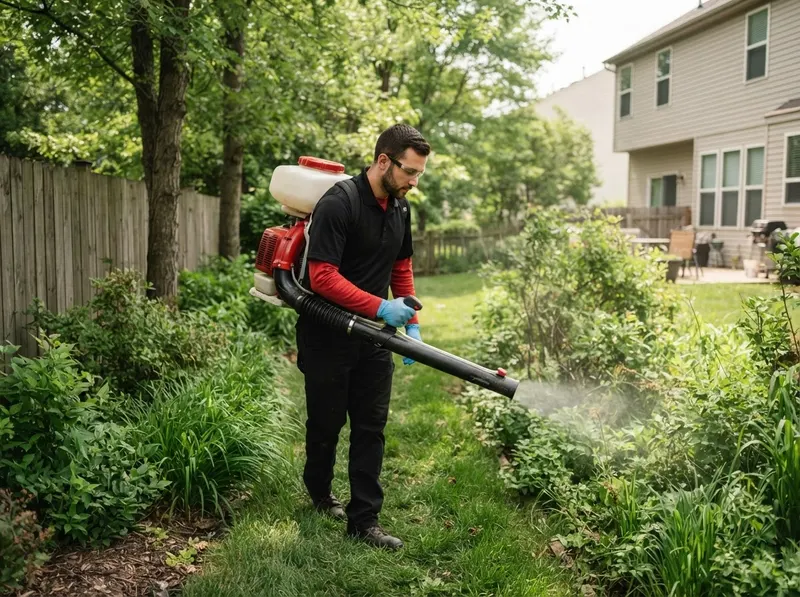
WillowForge Pest Care approaches vector reduction as outdoor infrastructure defense rather than blanket chemical saturation. Technicians begin by applying targeted biological larvicides containing Bacillus thuringiensis israelensis (Bti) to non-potable pooled water, bird baths, downspout extensions, and retention basins. This intervention prevents emergent pupae from developing into flying adults without harming domestic pets, beneficial pollinators, or aquatic ecosystems. For mature flying populations, technicians apply fine micro-droplet treatments directly to the undersides of broadleaf shrubs, dense turf edges, shaded patio overhangs, and perimeter fence lines using low-drift calibration. By grounding treatments in the guidelines of the American Mosquito Control Association, applications focus on day-resting zones rather than open air, minimizing chemical volume while maximizing population reduction.
Selecting a seasonal protection program versus a single special-event spray depends on site foliage density and adjacent moisture sources. Properties located in wooded pockets like Worthington Hills or mature tree canopies in Olde Towne East face continuous migration from surrounding unmanaged parcels. A single barrier application provides transient suppression for 72 to 96 hours, making it ideal for outdoor gatherings, but fails to disrupt overlapping reproduction cycles. A recurring 21-to-28-day management cycle breaks consecutive breeding phases by maintaining active residual barriers on structural foliage throughout peak summer temperatures. The trade-off involves seasonal planning: recurring applications require regular property access and clear ground-level pathways, yet provide reliable canopy defense across the entire outdoor season.
Implementation adheres to strict safety and regulatory parameters enforced by the Ohio Department of Agriculture. Technicians audit properties for potential runoff pathways to protect local watersheds monitored by the Ohio Environmental Protection Agency. The systematic workflow operates across three documented operational steps:
1. Site inspection maps all functional micro-climates, gutter traps, and low-lying perimeter grades across the lot.
2. Biological larvicide briquettes or granules are placed in captive water repositories, neutralizing larvae before emergence.
3. Residual barrier micro-misting is applied to perimeter foliage, shrub canopies up to 10 feet, and dark resting structures.
Homeowners must keep domestic dogs and cats indoors during mist application and allow 30 to 45 minutes for foliage surfaces to dry completely before re-entering treated yard zones.
Every job gets a firm, written price after a free on-site visit.
Tell us about your seasonal yard mosquito reduction job in Columbus and we'll send a clear, written quote, usually the same day.
 WillowForge Pest Care